
Russian Digest
Week of 5/11/26: Top stories I'm keeping an eye on

Ukraine struck energy facilities, a defense industry enterprise, and Sheremetyevo Airport during the largest attack on the Moscow region of the war. Three people were killed.
On the night of May 17, Ukrainian drones launched the largest air strike of the war on Moscow and the surrounding region. According to ASTRA’s OSINT analysis, the targets were the Elma technology park in Zelenograd (an electronics and optical manufacturing facility), the Solnechnogorsk loading station in the village of Durykino (a major oil product storage and transshipment facility), and Sheremetyevo Airport. A photo shows a fire near the third runway. Exilenova+ also reported fires at the station and the technology park.
Additionally, according to Supernova+, the strike hit the Raduga Design Bureau in Dubna, a developer of cruise missiles. According to Moscow Mayor Sergei Sobyanin, the Moscow Oil Refinery in Kapotnya was also attacked.
Read More: Moscow Times
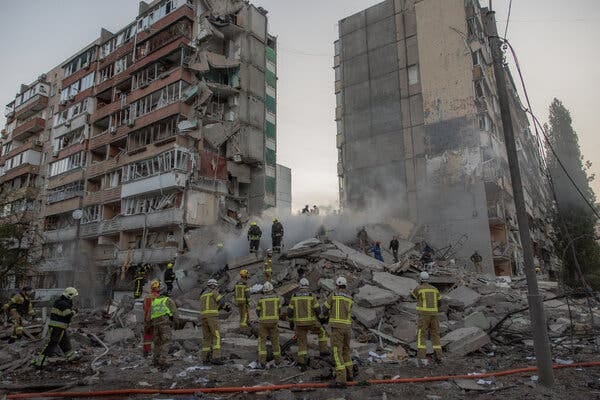
Russia Pummels Kyiv in the Largest Drone Attack of the War
At least 24 people were killed and dozens were wounded in a drone and missile assault, days after President Vladimir Putin of Russia said the war could end soon.
Russia pummeled Ukraine’s capital with hundreds of drones and missiles early Thursday, the latest in a string of deadly Russian strikes this week. The attacks suggested that President Vladimir V. Putin had little intention of de-escalating his war, after he declared recently that he believed it was “coming to a close.”
Explosions shook Kyiv, the capital, over several hours Thursday morning as Ukrainian forces tried to intercept and shoot down the drones and missiles, some of which evaded overwhelmed air-defense systems. The attack included cruise and ballistic missiles that Moscow often stockpiles for mass bombardments.
Russia launched a total of 1,428 drones and decoys into Ukraine between 8 a.m. Wednesday and 8 a.m. Thursday, by far the largest sustained daylong drone attack against Ukrainian cities during the war, according to a data set maintained by The New York Times, based on numbers from the Ukrainian Air Force.
Read More: New York Times
A Russian ship sank in mysterious circumstances. It may have been carrying submarine nuclear reactors to North Korea
A Russian cargo ship likely carrying two nuclear reactors for submarines, possibly destined for North Korea, suffered a series of explosions and sank in unexplained circumstances, about 60 miles off the coast of Spain, a CNN investigation has found.
The extraordinary fate of the Ursa Major has been shrouded in secrecy since it sank on December 23, 2024. But it may mark a rare and high-stakes intervention by a Western military to prevent Russia from sending an upgrade in nuclear technology to a key ally, North Korea, CNN reporting suggests. The ship set sail just two months after Kim Jong Un had sent troops to assist with Moscow’s invasion of Ukraine.
A flurry of recent military activity around its remains has deepened the mystery around its cargo and destination. US nuclear “sniffer” aircraft have flown over the sunken ship twice in the past year, according to public flight data. And its wreckage was also visited a week after it sank by a suspected Russian spy ship which set off four further explosions, according to a source familiar with the Spanish investigation into the incident.
Read More: CNN
U.S. Abruptly Cancels Deployment of 4,000 Troops to Poland
The Defense Department has abruptly canceled the deployment of more than 4,000 troops to Poland, three U.S. Army officials said on Thursday, part of a realignment of American forces in Europe announced this month that has caught many military officials off guard.
Two weeks ago, the Pentagon said it was withdrawing 5,000 troops from Germany and would redeploy them to the United States and other posts overseas. It also canceled a plan developed under the Biden administration to place a missile-equipped artillery unit in Europe.
Read More: New York Times
Poland scrambles to respond after Pentagon ditches troop deployment plan
Poland, one of the closest U.S. allies in Europe, was blindsided by this week’s surprise decision from Pentagon chief Pete Hegseth to cancel the planned deployment of 4,000 American troops to the country.
The government is now scrambling to respond while insisting that the move doesn’t undermine the country’s security.
The Polish-American alliance is “durable and lasting,” Defense Minister Władysław Kosiniak-Kamysz said on Friday. “Poland continues to be the most stable American ally in Europe.”
Deputy Defense Minister Paweł Zalewski told the TVN24 news channel on Thursday evening: “The assurance we have received is that the Americans do not plan to systematically reduce the U.S. presence in Poland.”
But there was no disguising that the U.S. move left Poland flat-footed.
Read More: Politico EU
Ukrainian drone pilots turn a military exercise in Sweden into a critical warning for NATO
The war game scenario was this: One of NATO ’s newest members, Sweden, was under threat by an unnamed country that was building up troops along the military alliance’s eastern border. And in an unusual twist, non-NATO member Ukraine was there to advise on drone warfare — and delivered a critical warning to the alliance.
A group of Ukrainian drone pilots, invited to teach Western forces how to win at drone warfare, destroyed Sweden’s troops in an exercise where the Ukrainians played the role of the aggressor, a 24-year-old drone pilot told the AP.
“They stopped the training three times” for troops to work out what to do better, but if it were real life they would have been dead, he said, giving his call sign Tarik in line with Ukrainian military regulations.
Read More: Associated Press
Russia Keeps Attacking U.S. Firms in Ukraine. The White House Is Silent.
The Russian drones slammed into the American-owned warehouses one after another.
Each announced its arrival with an eerie whine. Then came the blasts, ripping through a vast grain terminal in southern Ukraine and lighting up the night sky.
Seven drones in three minutes. The target, according to a video of the mid-April attack recorded by a truck driver, was the U.S. farming giant Cargill.
“This is insane,” the driver is heard repeating in the video, which was obtained and verified by The New York Times. “This is insane.”
The attack was one of the latest in a series of Russian strikes on major American companies since last summer, including facilities tied to Coca-Cola, Boeing, the snacks maker Mondelez and the tobacco giant Philip Morris.
Read More: New York Times
‘Disposable spies’: Poland records unprecedented number of Russian espionage cases
Warsaw has recorded an unprecedented number of hybrid attacks on its territory since 2024, Poland’s internal security service (ABW) said in a report published this week. Amateur spies once used by Russian intelligence services have laid the groundwork for more complex operations, according to a researcher following the emergence of these “single-use agents”.
Read More: France 24
Putin to visit Chinese leader Xi Jinping days after Trump’s trip to Beijing
Russian President Vladimir Putin will meet with Chinese leader Xi Jinping on a two-day trip to Beijing next week, the Kremlin said Saturday.
The announcement comes less than 24 hours after U.S. President Donald Trump finished his own state visit to China, where he also met Xi to discuss trade and the U.S. and Israel’s war in Iran.
In a statement, the Kremlin said that Putin’s trip, planned for May 19-20, had been scheduled to coincide with the 25th anniversary of the 2001 Sino-Russian Treaty of Friendship.
Read More: Associated Press
Taxes, costly credit, and labor shortages: Why private businesses in Russia are shutting down en masse
In the fifth year of the war, Russian businesses unrelated to the military-industrial complex have shifted their focus from growth to survival. They are being squeezed by taxes, expensive credit, rising prices, late payments, and shortages of workers and spare parts. Entrepreneurs are coping by splitting companies into smaller entities or moving into the shadow economy, farmers are leasing land to large holdings, and contracts are being pegged to the “Pyaterochka index” – seen as more reliable than Rosstat’s inflation figures. “Nobody is growing. Every year is worse than the last,” is the prevailing mood among the business owners interviewed by The Insider. Experts expect the number of small and medium-sized enterprises to fall by a third in the foreseeable future. The only exception is the IT sector, which profits from fixing the problems created by the authorities: since the start of 2025, the number of new businesses there has risen by 17%, largely because of the VPN boom.
Read More: The Insider
Russian Disinformation Network Manufactures Fake News Campaign About an Armenia-Russia War
A Russian-linked disinformation network has begun circulating a coordinated series of social media videos promoting narratives about a possible future war between Armenia and Russia, according to investigative reporting by the outlet Agentstvo. Novosti. on May 13.
The activity, documented by researchers, reportedly began two months before Russian leader Vladimir Putin publicly compared the events in Armenia and Ukraine. and involved at least 20 fabricated video clips distributed by accounts linked to Russian state influence operations.
Read More: United24 Media
Kremlin-style colonialism: Russian propaganda is actively preparing Africans for military service in Ukraine
Russia’s information operations in Africa expanded significantly since 2022, even if those efforts remain largely unnoticed against the much more visible backdrop of Russia’s military presence on the continent — via private military companies, the MoD-controlled Africa Corps, and the construction of military bases and dual-use facilities. The Kremlin is acting aggressively through the specially created “African Initiative,” even attempting to introduce its own social network, Afree. One of the propaganda campaign’s main objectives is the recruitment of contract soldiers for the war against Ukraine. Exploiting the catastrophic levels of poverty in parts of the continent, the Kremlin is imitating a “struggle against neocolonialism” the defense of traditional values in order to lure Africans to Russia before they are deployed as cannon fodder on the battlefield.
Read More: The Insider
I hate to say this but I think it’s way past time for Russia to feel lots more pain. They’ve been dishing it out for 4 years. Putin won’t stop unless his people start complaining louder.
wow. this is so necessary to get the news we don't hear about...even in Canada! thank you