
Russian Digest
Week of 6/1: Top stories I'm keeping an eye on

Bridge linking Crimea to southern Ukraine damaged in drone strike, Ukrainian military confirms
A bridge near the village of Chonhar connecting occupied Crimea with Russian-controlled parts of southern Ukraine was damaged in a Ukrainian drone strike overnight on June 7, the Ukrainian military confirmed, releasing video footage of the operation.
Earlier on June 7, Volodymyr Saldo, the Russian-installed head of the occupied part of Kherson Oblast, claimed the bridge had been damaged by Ukrainian drones.
The reported strike comes as Ukraine intensifies efforts to disrupt Russian logistics routes supplying occupied Crimea and front-line forces in southern Ukraine.
The attack on the Chonhar Bridge was a joint operation of Ukraine’s Code 9.2 drone unit and 1st Separate Assault Battalion, the military said. The strategic aim was to cut off Russian troops’ only means of delivering personnel, ammunition, and fuel to the front lines near Huliaipole from occupied Crimea.
Read More: Kyiv Independent
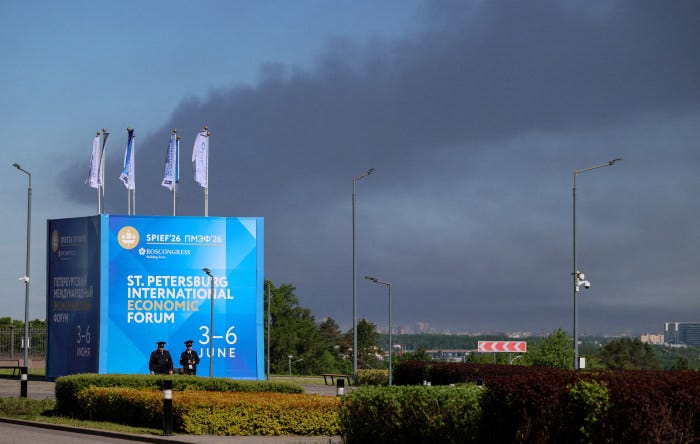
Ukraine Fires Wave of Drones at Russia on Last Day of Key Economic Forum
Ukraine fired hundreds of drones at Russia early Saturday, leaving one person dead and setting an oil depot ablaze on the final day of the country’s flagship economic forum in St. Petersburg, officials said.
Many of the drones targeted St. Petersburg itself, the second Ukrainian attack on the city in less than a week, with Ukraine’s SBU security service saying it had hit a naval base.
Moscow and Kyiv have intensified drone strikes on each other in recent months as U.S.-led diplomatic efforts to end the war, now in its fifth year, remain stalled and sidetracked by the war in the Middle East.
The strikes come a day after Russian President Vladimir Putin rejected Ukrainian counterpart Volodymyr Zelenskyy’s proposal for a meeting, drawing criticism from Zelenskyy, who accused him of “choosing war again.”
Read More: Moscow Times
Real-Time Satellite Intelligence Is Making Ukraine’s Drone Strikes Deadlier Than Ever
The small unit of the Ukrainian Armed Forces, stationed about 6 miles from the front line in the country’s southeast, knew there was something afoot in a building obscured by thick tree cover. The spring foliage hid its outline but not the signals from the electronic devices within.
The team launched a reconnaissance drone, which couldn’t see much through the trees. But the soldiers had another card to play: high-definition, near-real-time images taken by commercial satellites, delivered directly to their phones, tablets and laptops.
The satellite sensors showed the thick, metal frames of armored vehicles—the type used by senior Russian military officials—parked around the building. After three days of surveilling the site from orbit, the unit determined it was a Russian meeting spot for planning operations, members said. Then they struck the building and vehicles with an attack drone, one of the members said.
“It was good work,” he said. “We made problems for our enemy.”
Read More: Wall Street Journal
Ukrainian mothers’ fight to free children from Russians depicted in new opera
An opera by a Ukrainian composer that premiered in Kyiv this week tells the story of two mothers and a grandmother who risked their lives to travel 3,000 miles (4,800 km) to occupied Crimea to rescue children abducted by Russian forces.
“Mothers of Kherson”, co-commissioned by New York’s Metropolitan Opera, is based on the true stories of women who left the city in southern Ukraine after it was liberated in November 2022 to bring their children home.
They skirted around the 750-mile front line via Poland, Belarus and Russia to reach the camp in Crimea where their children were being held.
Ukraine says it has confirmed the abduction by Russia of around 20,000 children during the four-year war. In March, a U.N. commission concluded the deportation and enforced disappearance of Ukrainian children by Russia was a crime against humanity.
Read More: Reuters
House approves Ukraine aid and Russian sanctions, defying Trump and GOP leaders
More than a dozen GOP lawmakers defied their own leadership — and President Donald Trump — by voting with Democrats to approve a major bill to deliver billions of dollars in aid to Ukraine while imposing steep sanctions on Russia.
The House voted 226 to 195 to approve the package, which cracks down on Russia with new oil and gas sanctions, in its first big pro-Ukraine measure of Trump’s second term.
Speaker Mike Johnson has urged his members to oppose the measure, arguing in a closed-door meeting Wednesday that they should give Trump space to negotiate with Russia, according to a person in that meeting.
But ultimately, 18 Republicans – and one independent who frequently votes with Republicans – voted to pass the bill in what amounts to a rebuke of Trump’s posture toward Russia’s war in Ukraine, eager to send a message to their leadership after the party with Trump at its helm has drifted in recent years away from backing Ukraine as staunchly as it once had. The party is now fractured over the issue, with many Republicans arguing that the US should not send further aid to the war-torn country.
Read More: CNN
French navy seizes Russia-linked oil tanker in Atlantic
A suspected Russian oil tanker has been detained in the Atlantic, France has announced, in the latest seizure aimed at combatting Moscow’s “shadow fleet” of vessels contravening international sanctions.
The Tagor was detained on Sunday morning in international waters more than 400 nautical miles (740km) west of Brittany with the help of the UK and other partners, said the French president, Emmanuel Macron.
According to French authorities, the vessel was on its way from Murmansk in north-west Russia when it was seized.
Macron said the French navy boarded an oil tanker that was subject to international sanctions and sailing from Russia. He posted a video he said was of the seizure, which showed commandos descending from a helicopter on to a ship.
Read More: The Guardian
Chinese firms that help Russia are next for EU sanctions
The EU’s foreign policy service is pushing to sanction four Chinese companies it accuses of supporting Russia’s war against Ukraine, according to documents seen by POLITICO.
The four firms, likely to be included in the latest package of sanctions due to be approved at a gathering of EU foreign ministers next week, assist Russia’s shadow fleet, providing chemicals for Russia’s military and delivering components Moscow uses to build attack drones, officials said.
The move is likely to feed into rising tensions between Brussels and Beijing as European Commission President Ursula von der Leyen seeks the backing of EU capitals for a major crackdown on subsidized Chinese imports. Last week, China said it would take “resolute countermeasures and effective steps to safeguard its own interests” if the EU imposed additional trade restrictions.
Read More: Politico EU
Russia Floods Armenia With Disinformation Ahead of Election
Russia has unleashed what researchers are calling an unusually intense barrage of overt and covert influence operations before a parliamentary election on Sunday in Armenia, which has sought closer ties with Europe and the United States.
Groups linked to the Kremlin and Russian intelligence agencies have for months flooded the internet with attacks against Prime Minister Nikol Pashinyan, who has publicly clashed with Moscow after a breakdown in security cooperation between the two countries, according to government and independent researchers who track Russian influence campaigns.
The groups have spread scores of false narratives across social media platforms, accusing Mr. Pashinyan of corruption, a conspiracy to attack Russia and a multitude of crimes, including sexual assault and trafficking of human organs. Other messages include a claim that Mr. Pashinyan, 51, has hidden an incurable disease.
Many of the tactics are familiar from Russian campaigns targeting recent elections in the United States and Europe. The intensity has underscored the priority that Russia has given to ousting the government in Armenia, a former Soviet republic with about three million people that was once considered a reliable ally.
Read More: New York Times
Russia’s Threadbare Air Defenses
The morning of June 3 dawned bright and sunny in Vladimir Putin’s home city of St Petersburg, which might have been seen as a happy portent for the 29th International Economic Forum, the so-called Russian Davos that attracts numerous foreigners. Ukraine’s drone teams had other plans.
At least 50 explosive unmanned aerial vehicles (UAVs) circled the area and began to strike a range of targets, including a Russian corvette in dry dock and storage tanks at the city’s oil terminals. Towers of thick black smoke could be seen across the city. President Zelenskyy posted a video of what he drily called “long-range sanctions”.
Such attacks are becoming a regular feature of the war and are not limited to high-profile embarrassments of Putin’s regime. For example, extensive attacks on Russian supply routes across its land bridge to Crimea are causing serious supply problems for the military and civilians alike.
Read More: CEPA
Russia Rails Against the West but Welcomes Candace Owens and Andrew Tate
In the early days of President Trump’s second term, members of the Russian elite were full of hope that the new administration would fundamentally reset relations with Russia, pushing Ukraine out of mind and engaging in lucrative business deals.
More than 16 months later, the only thing the two sides seem to have agreed on is a hockey match between unspecified Russian and American players in Moscow, scheduled for July 1. It was announced on Thursday at President Vladimir V. Putin’s flagship annual economic conference in St. Petersburg.
Since the 2022 invasion of Ukraine, Russia has used the economic forum to show how it can withstand the pressure of Western sanctions by relying more on internal resources and by pivoting toward countries in the Middle East and Asia.
And yet Russia is still going out of its way to welcome some Americans, although U.S. sanctions remain in place and Moscow has yet to persuade the Trump administration to get back to business.
Read More: New York Times
Dozens of Azerbaijan Companies Manage Russian ‘Shadow Fleet’ Tankers
During the past couple years, a wave of newly established Azerbaijani firms quietly took charge of the safe management of dozens of oil tankers that are now under EU and U.K. sanctions for their role in Russia’s “shadow fleet” operations.
Brussels and London have targeted the tankers for their involvement in shipping Russian crude oil and petroleum products. Those exports have been sanctioned in response to Russia’s full-scale invasion of Ukraine in 2022.
At least 31 International Safety Management (ISM) companies were registered in Azerbaijan between 2023 and 2025, according to documents obtained by reporters.
Read More: OCCRP
Unholy order: Russia is building a system of religious control in occupied Ukraine
Russia is systematically building a system of religious control in the occupied territories of Ukraine. Russian troops are destroying and seizing churches as the new authorities force clergy to inform on parishioners and permit inspections during services — or worse. According to Ukrainian authorities, by the spring of 2025 Russian forces had killed at least 67 religious figures, and in the occupied Donetsk and Luhansk regions most non-Orthodox religious communities had either ceased to exist or gone underground.
Read More: The Insider
UK summons Russian ambassador after drone strike hit NATO ally Romania
Britain’s foreign ministry said on Wednesday it had summoned Russia’s ambassador after a Russian drone last week struck a residential building in NATO member Romania.
Foreign minister Yvette Cooper has condemned the incident, which occurred during a Russian attack on Ukraine and injured two people in the Romanian city of Galati, and said Britain stood united with allies to defend NATO territory.
Read More: Reuters
Russian spies are aggressively seeking Western technology as sanctions bite, officials say
Russia’s intelligence agencies have grown more aggressive in their efforts to steal Western technology and defense secrets as sanctions squeeze the country’s wartime economy, three senior European intelligence officials told The Associated Press.
Moscow’s agents are building fake companies, recruiting middlemen and deploying cyber spies and hackers who are gathering information that could also be used to attack key infrastructure, they said.
Four years of international sanctions have hampered Moscow’s ability to procure machinery, technology and research from Europe, while the grinding war in Ukraine has taxed key industries and pushed the country toward a potential financial crisis.
Read More: Associated Press
It would be truly wonderful - not to mention of enormous strategic significance - if Ukraine could liberate Crimea. Ukraine would again control its entire coast and the perpetual Russian menace to its shipping and major ports would be a thing of the past. The Red Army took it away from the White Army, the Germans and Romanians took it away from the Red Army, the Red Army took it back, Russia took it away from Ukraine, long passed time for Ukraine to take it back. The first step is to isolate it and turn the Sea of Azov into a Ukrainian lake. Slava Ukraini!
All day every day