
Russian Digest
Week of 7/13: Top stories I'm keeping an eye on

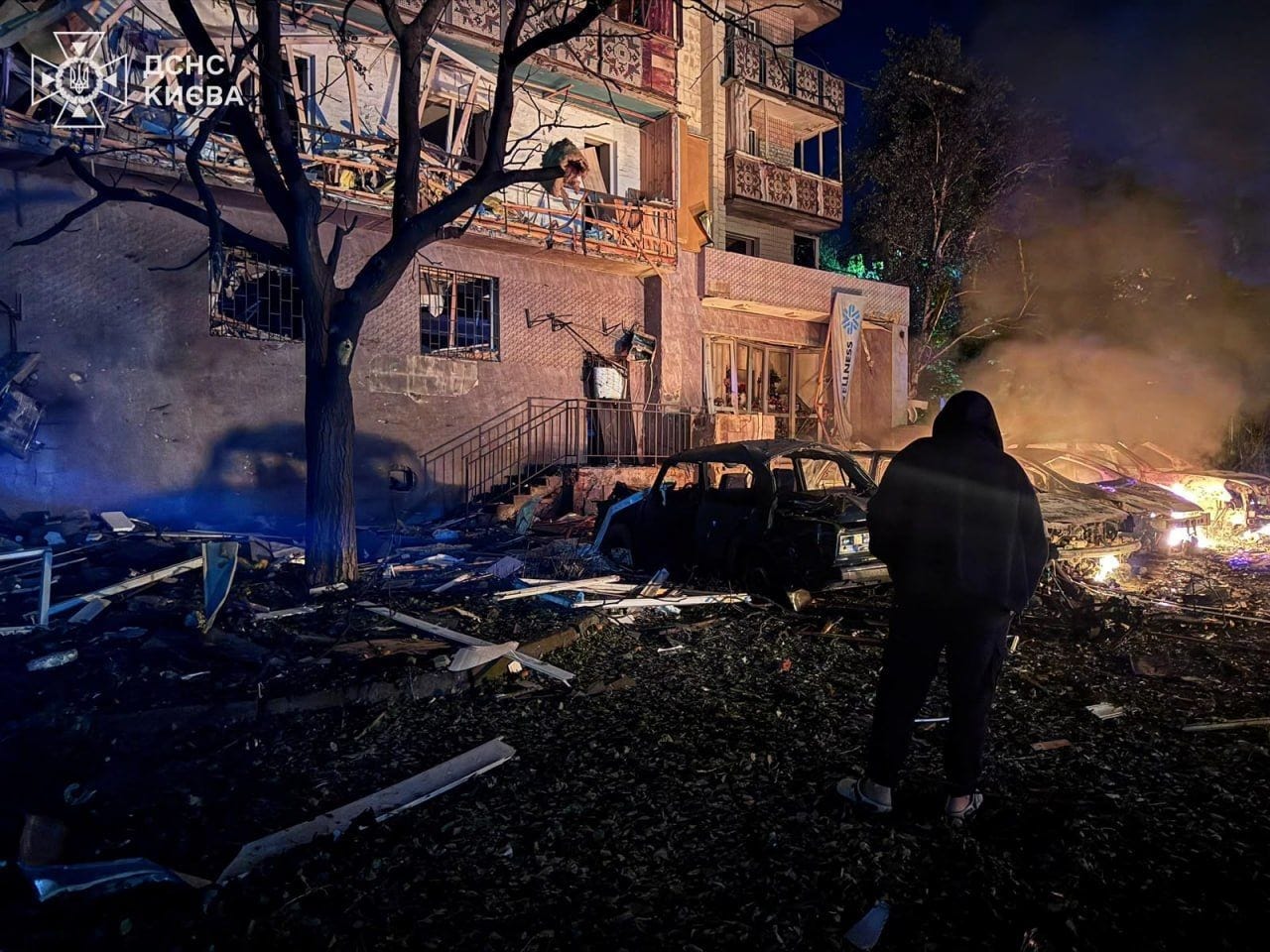
Russia unleashes one of its ‘largest ballistic missile attacks on Kyiv,’ at least 1 killed, 17 injured
At least one person has been killed, and 17 others injured, after a major Russian ballistic missile attack on Kyiv and the surrounding oblast overnight on July 19.
Russia deployed 125 drones, 25 ballistic missiles, 10 Zirkon hypersonic missiles, and six other missiles, Ukraine’s Air Force reported, with most projectiles aimed at Ukraine’s capital.
President Volodymyr Zelensky described the strike as one of Russia’s “largest ballistic missile attacks on Kyiv.”
“It was the scariest night of my life,” 30-year-old Eleonora Belei told the Kyiv Independent outside her damaged apartment building in the Lukianivska district, an area in the north-western section of central Kyiv that is frequently targeted by Russia.
Read More: Kyiv Independent
Two U.S. Troops Were Killed, One Is Missing After Iran Missile Attack in Jordan
Two U.S. servicemembers were killed and several were wounded in an Iranian attack on an air base in Jordan, further escalating a weeklong exchange of fire where both sides have been striking increasingly sensitive targets.
U.S. Central Command, which oversees American forces in the Middle East, confirmed the deaths and said another servicemember is missing as a result of the attack. Centcom later said the U.S. launched fresh strikes against Iran to punish the regime for targeting Americans and to degrade its ability to target shipping.
Manned and unmanned aircraft were also hit in the attack, according to people familiar with the matter.
Iran has adapted to U.S. defenses, firing missiles that travel at extremely high speeds and can maneuver as they streak toward the earth, according to U.S. officials. Iran’s ability to hit sensitive targets also has raised concerns that the regime is getting targeting help from China or Russia, the officials said.
Read More: Wall Street Journal
Ukraine Pounds Russian Ships in Its Campaign to Cut Off Crimea
Ukraine has opened another front in its intensifying blockade of Crimea, striking growing numbers of Russian vessels in the waters near the occupied peninsula as it tries to heap pressure on the Kremlin to end the war.
Kyiv is using its expanding arsenal of long-range drones to mount its largest campaign in the Sea of Azov since Moscow’s full-scale invasion in 2022. Advances in technology have only recently brought the sea, which is surrounded by Russia and Russian-occupied territory, in reach of drones piloted by Ukrainian soldiers.
These drones have been the backbone of weeks of attacks against Crimea as Ukraine tries to expose Russia’s president, Vladimir V. Putin, as unable to defend the peninsula, which Russia illegally annexed in 2014.
Ukraine has struck power stations, military infrastructure and fuel facilities, as well as roads and railways leading into Crimea. The attacks have caused power cuts and fuel shortages, which Mr. Putin has vowed to alleviate with increased sea deliveries to the peninsula.
Read more: New York Times
Baltics and Poland warn Russia could launch limited military or hybrid provocation against NATO
Lithuania’s president said Wednesday that intelligence assessments suggest that Russia is planning potential attacks on critical infrastructure in the Baltic states or Poland.
President Gitanas Nausėda said that authorities were monitoring the risk of attacks that could disrupt the country’s energy and transport systems, including facilities supporting Lithuania’s connections with the European electricity grid.
“I cannot deny that we have such information and that it concerns limited kinetic operations likely targeting critical infrastructure,” Nausėda told Lithuania’s BNS news agency.
Nausėda said that the intelligence didn’t identify a specific location or timing for the potential attacks. He said that such provocations could involve conventional or other means.
Read More: Associated Press
Ukrainian drones strike 12 Russian ‘shadow fleet’ vessels in Black Sea as Crimea comes under large-scale attack
Ukrainian forces struck 12 Russian shadow fleet vessels in the Black Sea on July 17, Robert “Madyar” Brovdi, commander of Ukraine’s Unmanned Systems Forces, said on Telegram.
The strikes came as Ukraine launched a large-scale attack on the Russian-occupied Crimean Peninsula. Explosions were reported across several cities, followed by fires at multiple locations.
Nine dry cargo ships, one oil tanker, one gas carrier, and one tugboat were hit in the Black Sea during the attack, Brovdi said.
According to Brovdi, the operation, codenamed “Molochka,” has been underway since July 6 and aims to destroy Russia’s shadow fleet operating in the Azov and Black Seas. During that period, Ukraine’s Unmanned Systems Forces struck 159 vessels.
Brovdi said 117 of the vessels were struck in the Sea of Azov and another 42 in the Black Sea.
Russia relies on a so-called shadow fleet, consisting largely of aging tankers sailing under flags of convenience, to export oil in circumvention of international sanctions, embargoes, and the G7-led price cap. The fleet enables the Kremlin to sustain oil revenues and continue financing its war against Ukraine.
Read More: Kyiv Independent
Ukraine to produce French missiles, orders war planes, Macron says
President Emmanuel Macron said on Monday that France would allow Ukraine to produce French-made cruise missiles, precision-guided bombs and air defence interceptor missiles after Kyiv ordered next generation Franco-Italian air defence systems and Rafale fighter jets.
“Earlier this afternoon President (Volodymyr) Zelenskiy and I agreed on a roadmap between our two countries, implementing what had been agreed in principle last November regarding our bilateral defense cooperation,” Macron said at a news conference following a meeting of some 25 leaders in Paris.
Read More: Reuters
Russia accused of spreading disinfo for German far right ahead of polls
Some German lawmakers and anti-Kremlin activists suspect Russia of inflaming sensitive regional divisions, smearing mainstream political parties and spreading disinformation to help the far right ahead of hotly contested regional elections in Germany.
In the former communist eastern states of Saxony-Anhalt and Mecklenburg-Western Pomerania, the Alternative for Germany (AfD) is topping the polls ahead of votes scheduled for September 6 and 20.
The anti-immigrant, pro-Russian party is aiming to take control of a regional government – which would be a first in Germany for the far right since 1945 – and deal a blow to Chancellor Friedrich Merz’s unpopular ruling coalition.
In recent months, posts spreading misinformation have been appearing in ever greater numbers across X, TikTok and Bluesky.
Read More: Euractiv
Crewing the shadows: The Insider exposes the firms staffing Russia’s sanctions-busting fleet of oil tankers and explains why they matter
Since the start of Russia’s full-scale war against Ukraine, companies from Kazakhstan, Cyprus, India, Moldova, Georgia, and Ukraine itself have published at least 1,000 job ads recruiting sailors for vessels in Russia’s “shadow fleet,” The Insider has found. Crewing companies have largely avoided sanctions so far, even though they may be more vulnerable to designations than the ships themselves. The sanctioning of a vessel often does not create major problems for exporters. Crewing companies, however, work with hundreds of sailors who have no interest in losing their livelihoods — meaning these firms have a strong incentive to protect their reputations.
Read More: The Insider
France to summon Russia’s ambassador over “sabotage and espionage in a dozen European countries”
France’s foreign minister said Monday that Russia’s ambassador in Paris would be summoned over “a vast cyber campaign” across Europe.
“We will also impose sanctions on nine individuals and four entities responsible for this cyber campaign, which was orchestrated by the FSB,” Russia’s primary national intelligence and security service, Foreign Minister Jean-Noel Barrot, said in an interview with BFMTV/RMC.
He made the announcement as the European Union and United Kingdom announced similar sanctions.
The Russian attacks, which allegedly targeted companies, government ministries and service operators, were attempts at “sabotage and espionage in a dozen European countries,” Barrot said.
Read More: CBS News
EU and Britain target Russian intelligence officers over a major cyberspying campaign
The European Union and Britain on Monday imposed sanctions on Russian military intelligence officers, hackers and private companies, denouncing what they described as a yearslong cyberespionage campaign to undermine governments in Europe.
The EU decision affects nine people and four entities accused of links to an online spying network that the bloc said has targeted governments and carried out sabotage operations against critical infrastructure like heating and power plants since 2010. Britain slapped sanctions on 24 people and entities.
EU foreign policy chief Kaja Kallas said those hit by the sanctions “contribute to Russia’s efforts to destabilize the EU, its member states and international partners.”
France, Germany, Poland, Cyprus, the Netherlands, Austria, Slovakia, Romania and Finland, “among others,” have fallen prey to the network, she said in a statement.
Read More: PBS News
Oil is not well: Ukrainian strikes on Russia’s energy infrastructure threaten Moscow’s federal budget
The price of Urals crude, which surged above $100 after shipping through the Strait of Hormuz was disrupted, fell back to around $50 before rebounding after the re-closure of the waterway. Still, Russia’s federal budget revenues are set to decline by hundreds of billions of rubles. At the same time, Ukrainian strikes on oil refineries are leading to refinery shutdowns that could force producers to reduce oil output. Russia’s oil industry not only contributes to the federal budget but also receives subsidies and tax breaks from it, meaning the losses could grow even larger. If oil production declines while budget payouts continue, the budget deficit could multiply several times over. In that event, even the state’s financial reserves would not be enough to cover the shortfall.
Read More: The Insider
European Password Manager Shares Origins and Updates with State-Certified Russian Firm
Key Findings
Though the Spanish company Passwork markets itself as entirely European, its password management software shares significant technical attributes with a Russian sister product, including a common codebase origin, synchronized software updates, and a near-identical user manual.
The Russian company, which advertises clients including sanctioned Russian missile manufacturers, has been certified by an agency under the Defense Ministry that requires a deep source-code review to search for “vulnerabilities or undeclared capabilities.”
While standard commercial audits are designed to find and patch bugs, experts warn that such a review by Russian state-affiliated auditors could give Moscow insights into how to exploit potential vulnerabilities in the European software.
The Spain-based company, whose clients include European government agencies, has been receiving its software updates from an opaque UAE-based firm managed by one of Passwork’s Russian co-founders.
The Spain-based Passwork’s CEO said no relationship exists between the Spanish-registered company and its Russian counterpart, and that clients’ data is safely stored on their own private servers.
Read Full Investigation: OCCRP
Wagner’s Remnants Are Running an Opioid Empire in the Center of Africa
The remnants of the Russian mercenary group Wagner have established a new foothold along the upper reaches of the Oubangui River, where they run a drug empire in the Central African Republic beyond the reach of law enforcement, or even Moscow itself.
This fief is based on tramadol. The painkiller is usually prescribed for relatively minor conditions, such as aching joints or people recovering from surgery. But when taken in sufficiently high doses, this opioid becomes a highly addictive stimulant known as the poor man’s cocaine.
Miners at Wagner’s gold mines rely on it to work long hours. Demonstrators rallying in support of Russia’s involvement in the region take the pills to stave off hunger and fatigue. Fighters involved in the country’s yearslong insurgency take it in high doses to make themselves braver in battle.
Read More: Wall Street Journal
Bombing the entrance to the metro is one of the most evil of all the evil things they have done.
thanks for all you do!